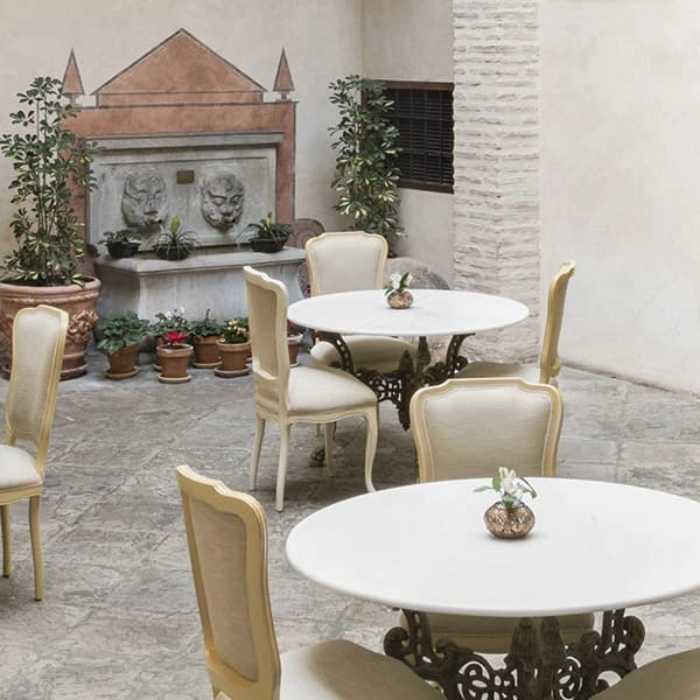
There is a moment at Casa 1800 when time stops. It’s not upon arrival, or waking up with the light of Granada or Seville coming through the window. It’s in the afternoon, when the sun begins to fade and the courtyard transforms into the hotel’s pulsating heart. It’s tea time.
In both hotels—Granada and Seville—the complimentary tea time is much more than a service: it’s a hospitality act inherited from generations, a silent invitation to slow down and savor the present. No reservation is needed, no need to ask. It simply appears, like good things do in Andalusia: unhurriedly, naturally, as if it had always been there waiting for you.
Tea time has deep roots in Spain. Already in the 18th century, it was customary in noble houses to offer chocolate, sweets, and coffee in the afternoon, a break in the workday that separated morning activity from evening rest. In the ancient palatial houses like the ones that now occupy our hotels—the 16th century Casa de los Migueletes in Granada, the 19th century Casa de los Alcalde Piñar y Miura in Seville—tea time was served in the central courtyard, under the soft light of the awning, to the sound of the fountain’s waters. Exactly like today.
In Casa 1800 Granada, the original Andalusian patio shelters guests under its Mudejar beams and centuries-old arches. The awning opens or closes as needed by the sun; tables are adorned with impeccable linens; candles discreetly wait until dusk falls. And in the center of it all, the fountain whispers as guests choose between a steaming cup of tea or a freshly made coffee.
In Seville, the scene repeats with the same cadence. The columned courtyard of the former palatial house on Rodrigo Caro street welcomes those returning from strolling through the Jewish Quarter, marveling at the Giralda, or getting lost in the narrow streets of Arenal. They arrive, sit down, and for a while there is nothing else but that moment.
There is something deeply comforting in that the only decision you have to make at five in the afternoon is this: tea or coffee? No rush, no bills to pay when you get up, no clock ticking. Just the pleasure of a hot drink, a sweet bite, and the silent spectacle of Andalusian light transforming minute by minute on the courtyard walls.
Guests come down freshly arrived from the Alhambra or the Alcázar, from wandering through the Albaicín or exploring Santa Cruz. Some still carry their cameras, others mentally kick off their shoes with the first sip. Mixed languages are heard, laughter, the clinking of spoons against cups. And in that small universe within the courtyard, everyone shares the same thing: that exact moment when the journey stops being tourism and becomes being.
In a world where hotels compete with extras and surcharges, there is something revolutionary in offering a complimentary tea time every day, with no conditions, no fine print. It’s the hospitality of the Andalusian grandmother, who sits you at the table before you finish saying “no, thank you.” The one that doesn’t ask if you want something, but instead puts it in front of you directly.
And perhaps that’s why, when guests write reviews or send us messages after their stay, tea time comes up again and again. They don’t mention it as a service: they remember it as a feeling. Because tea time at Casa 1800 is not just taken: it’s lived. And upon returning home, long after unpacking the suitcase, there is still the echo of that afternoon in the courtyard, with tea in hand and the certainty that, for a while, the whole world fit in a cup.
Casa 1800 Notebook 10.08.2026
There are buildings that hold memories within their walls, and then there is the old Casa de los Migueletes. An old photograph of Granada—those in sepia where the Darro River can still be seen flowing and the streets of the Albaicín climb slowly towards San Nicolás—is enough to understand that this corner has been witnessing Granada’s life for centuries. Today, that same place is Hotel Casa 1800 Granada. But before its twenty-five rooms welcomed travelers from around the world, this house was a palace, a barracks, and home to counts.
It was the last third of the 16th century when the lords of Cañaveral, Counts of Benalúa, decided to build their residence on the street that still bears their name today. Granada still breathed the echo of the Reconquista, and the new house was built—like many jewels of the Albaicín—on the plan of an important Arab dwelling that preceded it. Since then, the building has not stopped telling the history of the city in each of its stones.
Crossing its Castilian entrance is like stepping through a doorway in time. The hallway unfolds in a straight line, solemn, and at the back awaits the grand staircase that ascends to the upper floors. But it is in the courtyard where the house reveals its mixed soul: the Mudéjar corbels that crown the columns and the structure of uprights that support the upper floors remind us that here, for five centuries, the Andalusian legacy and the Castilian tradition have coexisted. On the facade, the Renaissance-style murals have withstood rains, centuries, and renovations, and today still adorn a building declared a protected historical heritage.
If the walls could talk, those of this house would tell more than one anecdote. For some years, it was the headquarters of the Migueletes troops, a rural police force that watched over the roads and properties of the Crown of Castile during the turbulent Carlist times. That militia was a direct heir of the Holy Brotherhood founded by the Catholic Monarchs in 1476, and its presence left in the house the name by which the people of Granada knew it for generations: the Casa de los Migueletes.
The 17th and 18th centuries brought modifications, expansions, and reforms that shaped the building’s unique character. Each intervention added a layer, a detail, a new story. The result is a place where no room is like another—and that, in a world of clone-like spaces, is a luxury in itself. Chandeliers, frescoes, domes, and period furniture coexist with the warmth of noble woods and the softness of Egyptian cotton.
In 2011, the building began the most recent chapter of its long biography: its transformation into Hotel Casa 1800 Granada. The restoration scrupulously respected the architectural heritage, and today its twenty-five rooms—each different, each with its own personality—offer guests something that no new hotel can promise: to sleep within history.
Few hotels in the world can say they open their door ten meters from the Paseo de los Tristes and just over a kilometer from the Alhambra. From some of its rooms, the Generalife stands out against the sky like a permanent viewpoint. The Albaicín, with its labyrinth of white alleys, surrounds the house on the other side. The entire historic center—declared a World Heritage Site by UNESCO—is explored on foot from here.
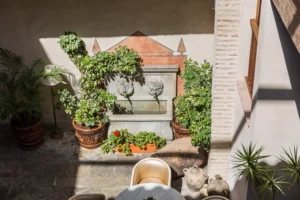
In the original Andalusian courtyard, where perhaps the migueletes once rested after their rounds, today complimentary tea time is served. The sound of water, the light filtered through the lattice windows, and the unmistakable profile of the Alhambra in the background create a scene that no photo filter can enhance.
At Hotel Casa 1800, we believe that heritage is not to be visited: it is to be experienced. Every guest who sleeps under our wooden roofs, who has breakfast next to a Renaissance fresco, or who gazes out into the Mudéjar courtyard, is participating in a history that began in the 16th century and that we continue to write together. Because Casa de los Migueletes is no longer just a historic building: it is a home where Granada is felt, breathed, and shared.
The Casa 1800 Notebook 24.07.2026
A universe that is recognized in the details
Hotels Casa 1800 are born from a simple and, for that reason, demanding idea: that luxury does not have to raise its voice to be noticed. That a stay can feel like a refuge: intimate, warm, and at the same time like an open door to the living history of Andalusia.
Here, the journey is not measured by the quantity of things that are “done,” but by how they are experienced: the changing light on an old façade, the silence of a courtyard in the middle of the afternoon, the way a destination becomes close when someone brings it to you naturally.
Seville and Granada, two cities, one heartbeat.
There are places that are best understood to the rhythm of the light. Seville says it in gold, among courtyards and long shadows; Granada whispers it in slopes, water, and silence. In both, Casa 1800 does not seek to “show” the city, but to accompany it: to be an emotional starting point, a place to enter and exit the day calmly.
A project that looks ahead (Córdoba 2027)
And while we continue writing this notebook, the project moves towards a new chapter: Córdoba 2027.
A 4* hotel with a pool, designed for slow rest after an intense city visit. And a private historic house with 6 luxurious suites, fully equipped, with a kitchen and all amenities for those who want Córdoba as it is truly wanted: with time, with calm, almost as if one lived there.
Casa 1800
In the end, traveling well is not about accumulating plans: it is about learning to look. And if something defines this project, it is precisely that: creating places where the destination does not begin when crossing the hotel door, but when feeling that, finally, everything is moving at the right speed.
27.05.2026 The Notebook of Casa 1800